
Where did Spanish come from?
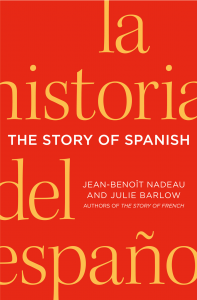 Just how did a quirky, obscure dialect spoken by a remote tribe of cattle farmers in northern Spain grow to become the common tongue of 400 million people in 22 countries? And why do so many people in Canada, Brazil, France and the United States want to learn Spanish today?
The Story of Spanish, to be published by St. Martin’s Press, NY, in May 2013, will answer these questions and many more.
The Story of Spanish will be a veritable “biography” of the Spanish language. It will introduce readers to the people, places and events that shaped the destiny and forged the personality of the Spanish language.
In the accessible style they have honed in their writing over the last decade, the authors will transport their readers back in time to the Roman Empire, the Kings of Castile and the New World explorers. Along the way, readers will discover Don Quixote, the Spanish Golden Age, the Liberator Simón Bolívar and great contemporary creators like Gabriel García Márquez and Pedro Almodovar – all of whom have influenced the destiny of the Spanish language.
Using their trademark style that mixes trivia, anecdote, observation and reflection, Nadeau and Barlow guide readers  through history. They explain why the portrait of king Alfonso X of Castile hangs in the U.S. Capitol and how the accent of Andalusia shaped American Spanish. They unearth surprising facts like why the Spanish peso was the currency of reference for U.S. trade until the 1850s, how vaqueros, estampidas and caballerangos became buckaroos, stampedes and wranglers – and who decided to put sour cream cheese on nachos.
The authors, Julie Barlow and Jean-Benoît Nadeau, are two trilingual Canadian writers, winners of dozens of journalism and literary prizes and well known as regular contributors to Quebec’s public affairs magazine, L’actualité. Their best-selling books on France and the French language have established them as experts in explaining cultural differences in the era of globalization.
In The Story of Spanish, readers will learn:
~ Why Spanish is so phonetic
~ How bad weather – and France – helped turn Castilian into the language of Spain
~ Why every Spanish-speaking country in the world has its own Spanish language academy
~ How the Spanish flag inspired the dollar ($) sign
~ Why Latinos love their music and telenovelas so much
…and more.
The Story of Spanish devotes many chapters to the increasing role the United States is playing in the Spanish-speaking world. Experts predict that by 2050, the U.S. will become the world’s largest Spanish-speaking country, even larger than Mexico. Nadeau and Barlow describe how Latin American countries and Spain are already working to boost their cultural and economic presence in what promises to be the world’s next Spanish-language superpower.
I enjoy your work in both languages and I’m looking forward to your account of the Spanish language (Italian with a heavy dose of Arabic?) If you ever decide to update Les Français aussi ont un accent, covering the quirky side of France, you might add wireless coverage to the mix. I am sure you aware that every shower in France still has the telephone with no hook, and that every French residence still has a unique method of entry with multiple keys, but in the 10 years since your last recorded observation, the French have also found a maddening method of providing wireless coverage: To have wireless, you must really, really want it.
Will you be publishing this in spanish as well? If so do you know when, and what the ISBN will be? Gracias.
I AM A 86 YEAR OLD THIRD GENERATION AMERICAN WHOSE ANCESTORS CAME FROM AUSTRIA,SPAIN,CHIHUAHUA MEXICO EL PASO TX USA AND BORN AND RAISED IN CALIFORNIA.I HAVE BEEN INTERESTED IN MY SPANISH BACKGROUND FOREVER,AND HAVE READ SINCE THE AGE OF TEN.I AM LOOKING FORWARD TO READING “THE STORY OF SPANISH” VERY MUCH
[…] about the history of Spanish, including why it’s so wonderfully easy to spell, I recommend The Story of Spanish by Nadeau and […]
The Story of Spanish signifies that Spanish is much more than tacos, flamenco, and bullfighting. It makes clear that how American cultural artifacts and customs are fundamentally Spanish including the dollar sign, barbecues, ranching, and cowboy culture.
By the way! The best essay writing service – [Edited web link out]
It’s been a decade since it was published, and yet there is still no Spanish language translation available????