





Jean Benoît Nadeau presents to AMWA Canada

Jean-Benoît presents to AMWA Canada

On February 29th, Jean-Benoît Nadeau will give a presentation to the Montreal chapter of the American Medical Writers Association on how to master the business side of writing.


  • Facebook
  • Twitter
  • email
  • Print
  • Google Buzz
  • LinkedIn

Julie Barlow and Jean-Benoît Nadeau are bestselling authors of books on language and culture. Partners in life and writing, the couple lives in Montreal, Canada with their twin daughters. Read more »

Love in the Time of French

French Heart

Photo: Lisa Morris

Is French really the language of love?

Because today is St. Valentine ’s Day, we thought the question was à propos. The Forum mondial de la langue française blog (The French Language World Forum) asked their readers to send in their favourite quotes, definitions and declarations of love.

Readers had no problem coming up with quotes that did justice to the four letter word. For example, Richard Seke from South Africa shared, “The verb “to love” is only good when it’s conjugated in the present. If it’s conjugated in the past, it makes you cry, and in the future, you can only dream.”

It’s not easy to combine love and language.  Jean Cocteau once said “Le verbe aimer est difficile à conjuguer : son passé n’est pas simple, son présent n’est qu’indicatif, et son futur est toujours conditionnel” (The verb “to love” is hard to conjugate: its past is not simple, its present is merely indicative, and its future is always conditional). Read more »

  • Facebook
  • Twitter
  • email
  • Print
  • Google Buzz
  • LinkedIn
Posted in French / Linguistics, Various | Leave a comment

French as an International Language

Excerpt taken from the book The Story of French


As an international language, French is said to be waning. English not so long ago surpassed French as the world’s lingua franca and is now the undisputed international language of business, diplomacy and academic exchange. In numbers of speakers, French ranks only ninth in the world, far behind Chinese, Hindi, Spanish and English, and neck-and-neck with Portuguese. It has relatively little economic clout; the combined GDP of the countries where French is spoken places it far behind English, well behind both Japanese and German, and just ahead of Spanish. French speakers seem to be so insecure that they pass laws banning other languages and spend millions of taxpayers’ dollars making sure their language gets used in literature, music and film. Read more »

  • Facebook
  • Twitter
  • email
  • Print
  • Google Buzz
  • LinkedIn
Posted in French / History, Various | Leave a comment

Why Bother Learning Different Languages?

Different Language BooksBig debate this morning over foreign languages in the pages of the New York Times. This time, it’s the economist Lawrence Summers, former president of Harvard from 2001 and 2006, who’s sparked the polemic. This is the same Mr. Summers who became famous in 2005 for declaring that the reason women are under-represented in engineering and in science is because of a “different availability of aptitude at the high end.”

This time, Summers is applying a simplistic analysis to language. In an article titled “What You (Really) Need to Know,” Summers coughs up a number of common place ideas about the future of education. In his fifth point, he argues that learning and speaking a foreign tongue is no longer worth the investment. Why? Because English will do the job.

The diverging opinions are worth reading, all the more so since evidently not all Americans share Mr. Summers’s point of view.

What do you think?

Read Lawrence Summers’ article »

The New York Times debate »

  • Facebook
  • Twitter
  • email
  • Print
  • Google Buzz
  • LinkedIn
Posted in Language Learning, Various | Leave a comment

Jean-Benoît Nadeau’s New Language Blog

Jean-Benoît Nadeau et le Forum mondial de la langue françaiseStarting today, Jean-Benoît will act as editor-in-chief of the Forum mondial de la langue française’s blog (The French Language World Forum). Every week, through interviews, photos and videos, an exciting new entry will be posted on French language from around the world. For the latest news on French language and culture, this is a blog worth bookmarking.

About the Forum: www.forumfrancophonie2012.org

  • Facebook
  • Twitter
  • email
  • Print
  • Google Buzz
  • LinkedIn
Posted in French / Francophonie, Various | Leave a comment

The ABC’s of the French Language

The French magazine Femme Actuelle Jeux recently published an “ABC of the French Language” based on our book The Story of French.

  • Facebook
  • Twitter
  • email
  • Print
  • Google Buzz
  • LinkedIn
Posted in French / History | Leave a comment

The United States of Languages

On January 14th, The New York Times published a very interesting article by writer Michael Erard explaining why the assumption that the U.S.A. is mainly a monolingual country is flawed.

He raises the key point that the United States Census Bureau only asks households what language they speak at home rather than a more telling question like, “Can you have a conversation in a language besides your mother tongue?” Until that is the case, Erard argues that “claims about American monolingualism will almost certainly be overstated.”

Read the article here »

Babel No More by Michael Erard

Who is predisposed to learn new languages? Michael Erard’s book, Babel No More: The Search for the World’s Most Extraordinary Language Learners, will answer that question.

The book came about after Erard wrote an article for a pop science magazine that aimed to explain the science behind hyperpolyglots (people who can speak six or more languages). He realized how much more could be researched and written about the fascinating topic of language superlearners.

For more information:

www.MichaelErard.com
www.BabelNoMore.com

  • Facebook
  • Twitter
  • email
  • Print
  • Google Buzz
  • LinkedIn
Posted in Language Learning, Various | Leave a comment

Nesbitt Will Stay Open… but will the EMSB start doing its job now?

By Julie Barlow

January 11, 2011, EMSB Commissioners voted unanimously to take Nesbitt School OFF the list of closures for 2012.

Along with a group of other parents, Julie has been fighting for the last nine months to keep her daughters’ school open. The struggle has been epic. We did interviews for TV, radio, newspapers and magazine, in English and in French, for both local and national media. We maintained a blog and a Facebook page. We lobbied commissioners. We convinced politicians of all stripes and all levels to support us.  And much more.

It’s been a long and hard battle, especially since we never knew why our school was on the chopping block in the first place. Nesbitt did not fit any of the “criteria” the EMSB had established for deciding which schools to close. Nesbitt is a big, successful, thriving school with a reputed and popular French immersion program, fabulous facilities, a central location, and harmonious, diverse community. Kids become perfectly bilingual at Nesbitt. There’s almost no bullying. No school is perfect, but we feel Nesbitt is about as close as you can get. Read more »

  • Facebook
  • Twitter
  • email
  • Print
  • Google Buzz
  • LinkedIn
Posted in Various | Leave a comment

Argot: Criminal Jargon?


Excerpt taken from the book The Story of French ( Ch. 8 )

The roots of argot go back as far as those of standard French. In the fifteenth century, Argot was the name of a crime syndicate of brigands, thieves and killers who spoke together in jargon (a deformation of the Norman word garg, throat). Jargon was not a language so much as a system of words that criminals used so they couldn’t be understood by anyone outside the group, in particular the bourgeois and aristocrats they robbed and the authorities who pursued them. By the seventeenth century the bourgeois referred to this criminal jargon as argot. Read more »

  • Facebook
  • Twitter
  • email
  • Print
  • Google Buzz
  • LinkedIn
Posted in French / History, Various | Leave a comment

Happy New Year 2012!

Best wishes for the year 2012… That is, if it’s actually the year 2012–something that is far from being certain. For Muslims, the year is 1433. For the Chinese, it’s 4709, keeping in mind that in 2011 their new year began on January 23rd.

And in our own Gregorian/Western/Christian calendar, the year 2012 is not completely accurate. This is because of one monk, Denys le Petit, who experienced technical difficulties when it came to counting. Perhaps he used his fingers to count and forgot all about the 0. As a result, Jesus Christ’s birth is in year 1 as opposed to year 0. In addition, le Petit was somehow off in his calculations by four years. In fact, Christ was born in the year 4 Before Christ.

Hopefully, all these calendrical (mis)calculations won’t make your head spin. It would be a shame to start the New Year with a headache. Instead, we wish you a very happy, prosperous and most pleasant new year!

Jean-Benoît , Erika, Nathalie and Julie 

  • Facebook
  • Twitter
  • email
  • Print
  • Google Buzz
  • LinkedIn
Posted in Various | Leave a comment

The Revolutionary Calendar

Excerpt taken from the book The Story of French (Ch. 6)

Photo: Imageshack.us

The revolutionary government hired the poet Fabre d’Églantine–better known for his bedtime song “Il pleut, il pleut, bergère” (“It’s raining, it’s raining, shepherdess”)–to come up with new names for the days and months. D’Églantine was inspired by the weather and natural cycles, so he used different suffixes for each season, attached to Latin words that corresponded to the typical weather for each month. The fall months were Vendémiaire, Brumaire and Frimaire; the winter months were Nivôse, Pluviôse and Ventôse; the spring months were Germinal, Floréal and Prairial; and the summer months were Messidor, Thermidor and Fructidor. D’Églantine wanted to rename the days after vegetables, animals and farm tools, but the National Assembly probably realized that they were already pushing their luck by trying to name the days after Latin numbers (primedi, duodi, tridi and so on). Read more »

  • Facebook
  • Twitter
  • email
  • Print
  • Google Buzz
  • LinkedIn
Posted in French / History, Various | Leave a comment
The Story of French

The Story of French, Can. ed.

The first biography of the French language.

The Story of French

The Story of French, US ed.

The first biography of the French language.

Story of French

The Story of French, UK ed.

The first biography of the French language.

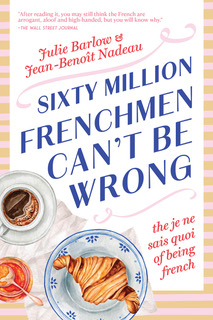
Sixty Million Frenchmen Can't Be Wrong

Sixty Million Frenchmen Can't Be Wrong

A voyage through the French mindset.